
Trace chemo waste, incinerated and documented.
Yellow-container trace chemotherapy waste — empty vials, IV bags, tubing, gowns, and gloves with trace (under 3%) residual — collected and incinerated at a permitted facility, with a Certificate of Destruction every time. We take trace chemo only; bulk chemo isn't accepted.
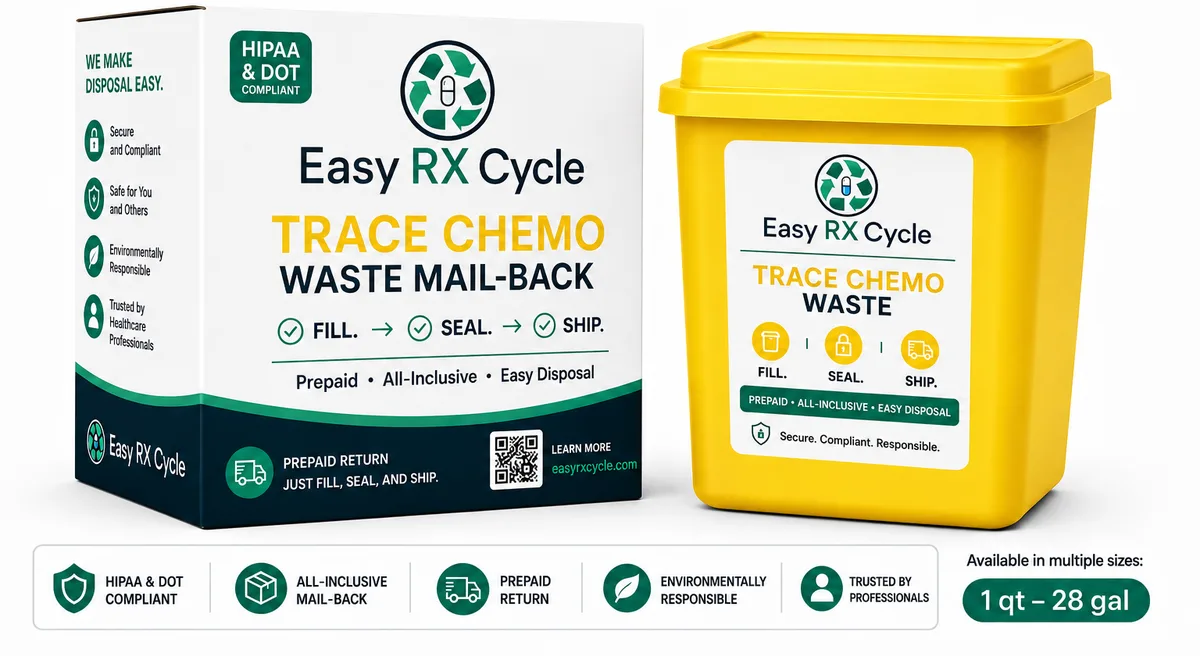
The yellow-container stream.
Trace chemo waste is chemo-contaminated materials with only residual drug left. Bulk chemo is handled differently — we sort it out.
- Empty chemo vials & syringes
- IV bags, tubing & lines
- Contaminated PPE (gowns, gloves)
- Prep-area trace waste
- Under-3%-residual materials
- Chemo-contaminated sharps
Trace vs. bulk, drawn clearly.
The one line between trace and bulk chemo, the RCRA-empty rule, and how USP 800 governs handling through disposal.
Trace chemo waste
Materials that held or contacted a hazardous drug but are now RCRA-empty — the everyday chemo stream.
- RCRA-empty vials, syringes & IV bags
- Tubing, gloves, gowns & contaminated PPE
- Empty containers meeting the RCRA-empty test
- P-listed drug waste or unused drug (bulk)
- More than de minimis residual drug
- Non-chemo sharps or RMW
Bulk chemo & P-listed waste
Unused drug and P-listed chemo agents that exceed the trace threshold.
- Unused/expired chemo drug
- P-listed agents (e.g. certain nitrogen mustards)
- Containers with more than de minimis residue
- RCRA-empty trace materials (yellow stream)
- Non-hazardous pharmaceutical waste
USP 800 handling
The standard that governs how hazardous drugs — including chemo — are handled through disposal.
- Designated PPE for chemo handling
- Contained, labeled chemo waste at point of use
- A facility Assessment of Risk where applicable
- Chemo waste in ordinary trash or RMW
- Handling without the USP 800 controls
The Trace Chemo Waste Guide
Trace vs. bulk, the RCRA-empty rule, the yellow-container system, and how USP 800 shapes safe handling — plus a checklist and FAQ.
Contain, ship, incinerate.
Yellow containers
Use the labeled trace-chemo containers for empty vials, tubing, and contaminated PPE.
Keep bulk out
Bulk chemo isn't accepted in trace kits, and P-listed drug waste goes in the RCRA kit.
Compliant transport
Shipped to a permitted incineration facility under the correct documentation.
Incinerated + documented
Destroyed by incineration — Certificate of Destruction returned to your account.
What trace chemo disposal costs.
One flat price per kit: the yellow container, shipping both ways, incineration, and your Certificate of Destruction. No route fees, no fuel surcharges, no contract.
| Kit size | Price | Per gallon | Usually fits |
|---|---|---|---|
| 2 Gallon | $105 | $52.50 | A single prep area or occasional infusions |
| 8 Gallon | $265 | $33.13 | A small infusion suite |
| 18 Gallon | $310 | $17.22 | A busy infusion center or compounding room |
| 28 Gallon | $445 | $15.89 | High volume, fewer shipments |
Three ways facilities overpay
- Sending trace waste as hazardous. RCRA-empty vials, tubing, and PPE belong in a trace kit (from $105), not a hazardous waste kit (from $145). Segregating at the point of use keeps the cheaper stream cheap.
- Shipping containers half full. Larger kits cost less per gallon. Pick the size you can fill in a reasonable time, and keep the container closed between uses.
- Paying route fees for a small stream. A trace kit ships by mail, so a few gallons a month doesn’t need a hauler stop or a fuel surcharge.
The reverse is not a savings: bulk chemo (unused drug, partial doses, spill cleanup) never goes in a trace container. It is managed as RCRA hazardous waste on a separate path. Over 28 gallons a month, or several locations? Get a quote and we’ll price a program.
Manifested & incinerated
Every trace-chemo container is manifested and incinerated at a permitted facility.
Permitted incineration
Trace chemo is incinerated at a permitted facility, as required.
Protects your staff
Proper yellow-container handling supports USP 800 hazardous-drug safety.
Documented every time
Certificate of Destruction on every shipment, archived and audit-ready.
For oncology & infusion providers.
Trace chemo waste questions.
What is trace chemotherapy waste?
Trace chemo waste is materials contaminated with only residual (trace) amounts of chemotherapy drugs — empty vials and syringes, IV bags, tubing, and contaminated PPE — generally defined as RCRA-empty with under 3% residual by weight. It goes in yellow containers and is incinerated.
What’s the difference between trace and bulk chemo waste?
Trace chemo is contaminated materials with residual drug; bulk chemo is unused drug, spill cleanup, or containers with more than trace amounts. Bulk chemo must be managed as RCRA-hazardous waste, and our trace kits don't accept it.
What color container is used for trace chemo?
Yellow containers labeled for trace chemotherapy waste. They’re used for empty chemo vials, tubing, IV bags, and contaminated PPE destined for incineration.
How much does trace chemo disposal cost?
Our trace chemo mail-back kits run $105 to $445, depending on size. Each price includes the yellow container, prepaid shipping both ways, incineration at a permitted facility, and a Certificate of Destruction. No route fees and no contract.
Does trace chemo have to be incinerated?
Yes — trace chemotherapy waste is destroyed by incineration at a permitted facility. We handle transport and provide a Certificate of Destruction.
How does this relate to USP 800?
USP 800 governs safe handling of hazardous drugs, including chemo, to protect staff. Proper trace-chemo segregation and disposal is part of a compliant hazardous-drug program.
Learn more about chemo waste.
Chemo disposal guide
Trace vs. bulk, yellow container, USP 800, cost.
Trace vs. bulk
The split that decides where it goes.
The yellow container
Exactly what belongs in it.
USP 800
Hazardous-drug handling standards.
Bulk / RCRA-hazardous chemo
When chemo is a hazardous waste.
Color codes
Yellow, black, red & blue explained.
Trace Chemotherapy Waste in all 50 states.
Mail-back to any U.S. address and scheduled pickup nationwide — pick your state:
Handle chemo waste compliantly.
Get a quote for trace chemotherapy waste disposal — segregated, incinerated, and documented.