
Trace chemotherapy waste disposal in Ohio.
Compliant disposal of trace (RCRA-empty) chemotherapy waste for Columbus, Cleveland, Cincinnati, Toledo and communities across Ohio — empty vials and syringes, trace-contaminated PPE and IV sets — collected in yellow containers, incinerated, and documented. We take trace chemo only; bulk chemo (visible drug remaining) isn't accepted.
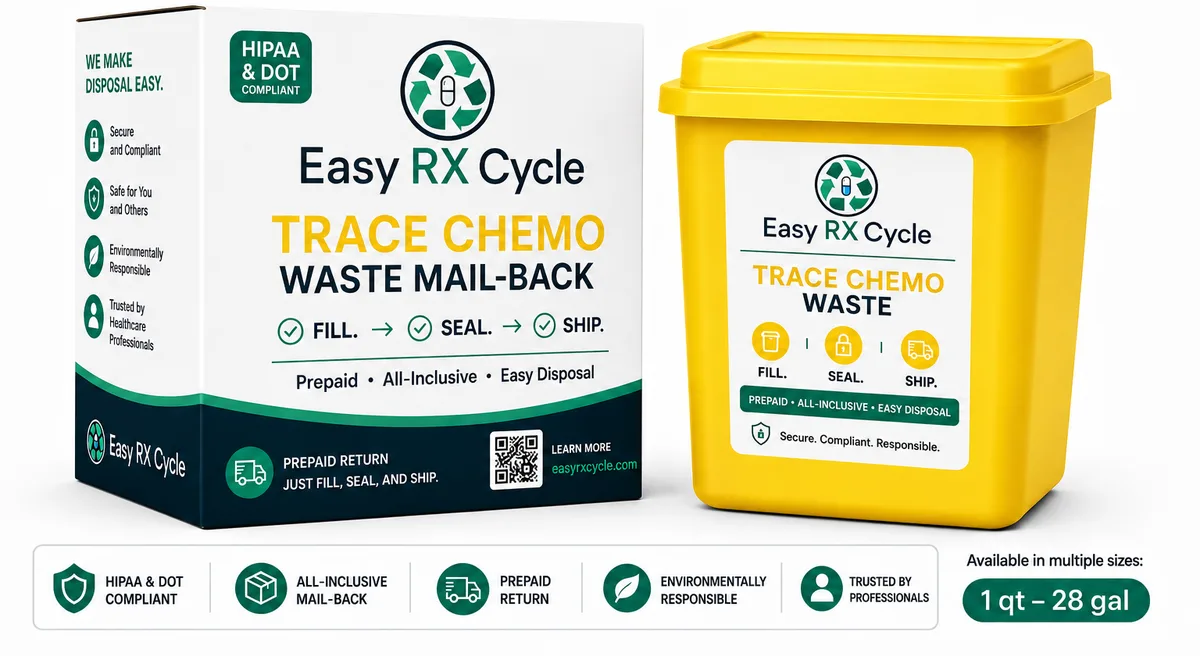
Every trace chemo item you generate in Ohio.
RCRA-empty chemo waste, incinerated and documented.
- Empty (RCRA-empty) chemo vials & syringes
- Trace-contaminated PPE, gowns & gloves
- IV bags & tubing with trace residue
- Empty drug containers
- Contaminated prep materials
- Yellow-container trace waste
Pick a size. We handle the rest.
Prepaid, compliant, and documented — shipped to any Ohio address.
Infusion chairs, clinics and compounding sites in Columbus with light trace-chemo volume.
Busy oncology and infusion centers across Ohio — with an expedited option when timing matters.
Hospital units and high-volume Ohio infusion programs.
The largest trace-chemo container — or ask about scheduled pickup for multi-site Ohio programs.
The Trace Chemotherapy Waste Guide
USP <800> handling, what makes waste “trace” vs. bulk (RCRA-hazardous), the yellow-container rule, and how any site disposes of trace chemo compliantly — plus a checklist and FAQ.
Mail-back or scheduled service, statewide in Ohio.
Order your kit
Yellow trace-chemo container shipped to any Ohio address with a prepaid return label — or set scheduled service for Columbus and higher-volume sites.
Fill the yellow container
Place only trace (RCRA-empty) chemo waste in the yellow container. Bulk chemo isn't accepted, and P-listed drug waste goes in the RCRA kit.
Ship or pickup
Tracked door-to-door to our permitted facility under DOT rules.
Get documentation
Trace chemo is incinerated, and your Certificate of Destruction is emailed to you.
Ohio & federal trace-chemo rules, handled.
Chemotherapy waste splits by how much drug remains. “Trace” waste — RCRA-empty containers and trace-contaminated materials — goes in yellow containers for incineration. Bulk or P-listed chemo (for example, discarded product or certain hazardous drugs) is a RCRA hazardous waste and must be managed as such. Federally, OSHA and USP General Chapter <800> govern safe handling of hazardous drugs, and the DOT governs transport. In Ohio, the Ohio Environmental Protection Agency (Ohio EPA) and the Ohio Board of Pharmacy add their requirements. Easy Rx Cycle takes trace chemo only — we manifest it and incinerate it at a permitted facility, documented on every order.
- USP <800>: hazardous-drug handling & containment
- Trace only: RCRA-empty chemo waste in yellow containers, incinerated; bulk chemo not accepted
- DOT: 49 CFR compliant packaging & prepaid return shipping
- Ohio: state environmental & Board of Pharmacy requirements
- State regulator
- Ohio Environmental Protection Agency (Ohio EPA)
- Medical waste rule
- Ohio Administrative Code Chapter 3745-570 (infectious waste), which replaced the older Chapter 3745-27 rules. Local health districts handle inspections.
- What generators must do
- A generator of 50 lbs or more of infectious waste in any month must register with Ohio EPA within 30 days after that month ends (OAC 3745-570-125). Smaller generators don't register but still follow the handling rules.
- Pharmacy oversight
- Ohio Board of Pharmacy
- Statewide drug take-back law
- No statewide take-back law — disposal via mail-back kits, pharmacy kiosks & DEA collectors
- Home sharps in household trash
- Allowed only in an approved, puncture-resistant container, subject to local rules
Ohio healthcare footprint: roughly 1,300 pharmacies, 192 hospitals, 5,588 physician offices, 3,883 dental practices, 924nursing & long-term-care facilities, and 1,206 veterinary clinics — every one a generator of regulated waste we serve. Source: U.S. Census County Business Patterns, 2022.
Official source: Ohio Administrative Code Chapter 3745-570
Federal rules (OSHA 29 CFR 1910.1030, DOT 49 CFR, EPA RCRA, DEA 21 CFR 1317) apply in Ohio on top of the above.
Built for Ohio sites that handle hazardous drugs.
Trace Chemotherapy Waste Disposal in Ohio: questions.
What is trace chemotherapy waste in Ohio?
Trace chemo is RCRA-empty waste — vials and syringes emptied of drug, plus trace-contaminated PPE and IV sets. It goes in yellow containers for incineration. We take trace chemo only — bulk chemo with visible drug remaining isn't accepted. We serve Columbus, Cleveland, Cincinnati, Toledo and all of Ohio.
What's the difference between trace and bulk chemo waste?
“Trace” means the container is RCRA-empty (drug removed to the extent practical); it's incinerated as trace chemo. “Bulk” means usable drug remains — that's a RCRA hazardous waste with stricter handling, and our trace kits don't accept it. Keeping them separate is a common Ohio compliance point.
What color container does trace chemo go in?
Yellow. Yellow containers signal trace chemotherapy waste bound for incineration — separate from red (RMW), black (RCRA hazardous), and blue (pharmaceutical). Our Ohio kits use the correct container for the stream.
Who regulates chemotherapy waste in Ohio?
OSHA and USP <800> govern safe handling, the DOT governs transport, and the EPA's RCRA rules govern bulk chemo. In Ohio, the state environmental agency and Board of Pharmacy add requirements. We manifest and destroy trace chemo to all of them.
Do you serve Columbus and the rest of Ohio?
Yes — mail-back reaches every ZIP in Ohio, from Columbus to Toledo, and scheduled service is available for higher-volume sites across the state.
Handle trace chemo the compliant way in Ohio.
Order a yellow-container kit in minutes, or get a same-day quote for scheduled service across Ohio.