
Trace chemotherapy waste disposal in Kentucky.
Compliant disposal of trace (RCRA-empty) chemotherapy waste for Louisville, Lexington, Bowling Green, Owensboro and communities across Kentucky — empty vials and syringes, trace-contaminated PPE and IV sets — collected in yellow containers, incinerated, and documented. We take trace chemo only; bulk chemo (visible drug remaining) isn't accepted.
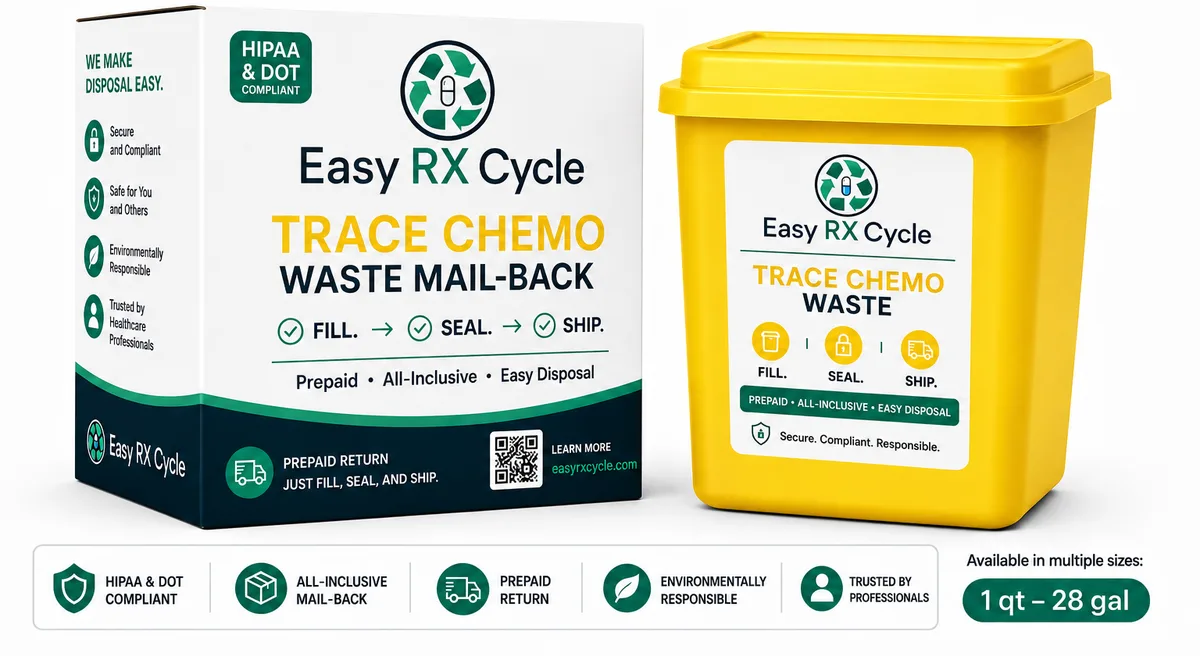
Every trace chemo item you generate in Kentucky.
RCRA-empty chemo waste, incinerated and documented.
- Empty (RCRA-empty) chemo vials & syringes
- Trace-contaminated PPE, gowns & gloves
- IV bags & tubing with trace residue
- Empty drug containers
- Contaminated prep materials
- Yellow-container trace waste
Pick a size. We handle the rest.
Prepaid, compliant, and documented — shipped to any Kentucky address.
Infusion chairs, clinics and compounding sites in Louisville with light trace-chemo volume.
Busy oncology and infusion centers across Kentucky — with an expedited option when timing matters.
Hospital units and high-volume Kentucky infusion programs.
The largest trace-chemo container — or ask about scheduled pickup for multi-site Kentucky programs.
The Trace Chemotherapy Waste Guide
USP <800> handling, what makes waste “trace” vs. bulk (RCRA-hazardous), the yellow-container rule, and how any site disposes of trace chemo compliantly — plus a checklist and FAQ.
Mail-back or scheduled service, statewide in Kentucky.
Order your kit
Yellow trace-chemo container shipped to any Kentucky address with a prepaid return label — or set scheduled service for Louisville and higher-volume sites.
Fill the yellow container
Place only trace (RCRA-empty) chemo waste in the yellow container. Bulk chemo isn't accepted, and P-listed drug waste goes in the RCRA kit.
Ship or pickup
Tracked door-to-door to our permitted facility under DOT rules.
Get documentation
Trace chemo is incinerated, and your Certificate of Destruction is emailed to you.
Kentucky & federal trace-chemo rules, handled.
Chemotherapy waste splits by how much drug remains. “Trace” waste — RCRA-empty containers and trace-contaminated materials — goes in yellow containers for incineration. Bulk or P-listed chemo (for example, discarded product or certain hazardous drugs) is a RCRA hazardous waste and must be managed as such. Federally, OSHA and USP General Chapter <800> govern safe handling of hazardous drugs, and the DOT governs transport. In Kentucky, the Kentucky Energy & Environment Cabinet and the Kentucky Board of Pharmacy add their requirements. Easy Rx Cycle takes trace chemo only — we manifest it and incinerate it at a permitted facility, documented on every order.
- USP <800>: hazardous-drug handling & containment
- Trace only: RCRA-empty chemo waste in yellow containers, incinerated; bulk chemo not accepted
- DOT: 49 CFR compliant packaging & prepaid return shipping
- Kentucky: state environmental & Board of Pharmacy requirements
- State regulator
- Kentucky Energy & Environment Cabinet
- Medical waste rule
- No single medical-waste rule. Duties are split: Cabinet for Health and Family Services rules (902 KAR 20) require hospitals, nursing homes and similar facilities to treat medical waste or use a disposal contractor; Kentucky OSH covers sharps, containers and labeling; the Division of Waste Management permits transfer stations and landfills.
- What generators must do
- No state generator registration. Medical waste haulers register with, and report yearly to, each county they serve (Form DEP 5033).
- Pharmacy oversight
- Kentucky Board of Pharmacy
- Statewide drug take-back law
- No statewide take-back law — disposal via mail-back kits, pharmacy kiosks & DEA collectors
- Home sharps in household trash
- Allowed only in an approved, puncture-resistant container, subject to local rules
Kentucky healthcare footprint: roughly 841 pharmacies, 110 hospitals, 2,627 physician offices, 1,463 dental practices, 315nursing & long-term-care facilities, and 555 veterinary clinics — every one a generator of regulated waste we serve. Source: U.S. Census County Business Patterns, 2022.
Official source: Kentucky Energy & Environment Cabinet: medical waste
Federal rules (OSHA 29 CFR 1910.1030, DOT 49 CFR, EPA RCRA, DEA 21 CFR 1317) apply in Kentucky on top of the above.
Built for Kentucky sites that handle hazardous drugs.
Trace Chemotherapy Waste Disposal in Kentucky: questions.
What is trace chemotherapy waste in Kentucky?
Trace chemo is RCRA-empty waste — vials and syringes emptied of drug, plus trace-contaminated PPE and IV sets. It goes in yellow containers for incineration. We take trace chemo only — bulk chemo with visible drug remaining isn't accepted. We serve Louisville, Lexington, Bowling Green, Owensboro and all of Kentucky.
What's the difference between trace and bulk chemo waste?
“Trace” means the container is RCRA-empty (drug removed to the extent practical); it's incinerated as trace chemo. “Bulk” means usable drug remains — that's a RCRA hazardous waste with stricter handling, and our trace kits don't accept it. Keeping them separate is a common Kentucky compliance point.
What color container does trace chemo go in?
Yellow. Yellow containers signal trace chemotherapy waste bound for incineration — separate from red (RMW), black (RCRA hazardous), and blue (pharmaceutical). Our Kentucky kits use the correct container for the stream.
Who regulates chemotherapy waste in Kentucky?
OSHA and USP <800> govern safe handling, the DOT governs transport, and the EPA's RCRA rules govern bulk chemo. In Kentucky, the state environmental agency and Board of Pharmacy add requirements. We manifest and destroy trace chemo to all of them.
Do you serve Louisville and the rest of Kentucky?
Yes — mail-back reaches every ZIP in Kentucky, from Louisville to Owensboro, and scheduled service is available for higher-volume sites across the state.
Handle trace chemo the compliant way in Kentucky.
Order a yellow-container kit in minutes, or get a same-day quote for scheduled service across Kentucky.