
Quick definition
Easy Rx Cycle's document proving the customer's waste was destroyed — how, when and what. Every mail-back product gets one, and the customer keeps it for DEA, EPA, OSHA or state inspections.
The Certificate of Destruction
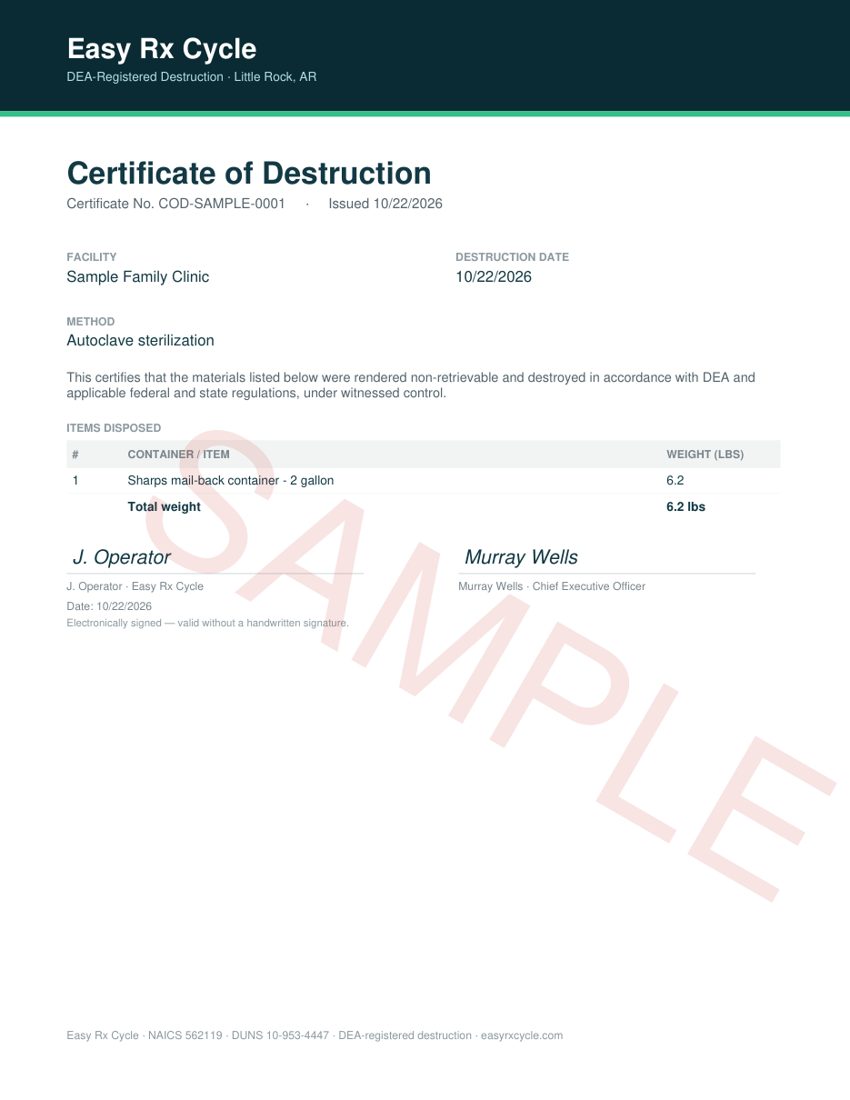
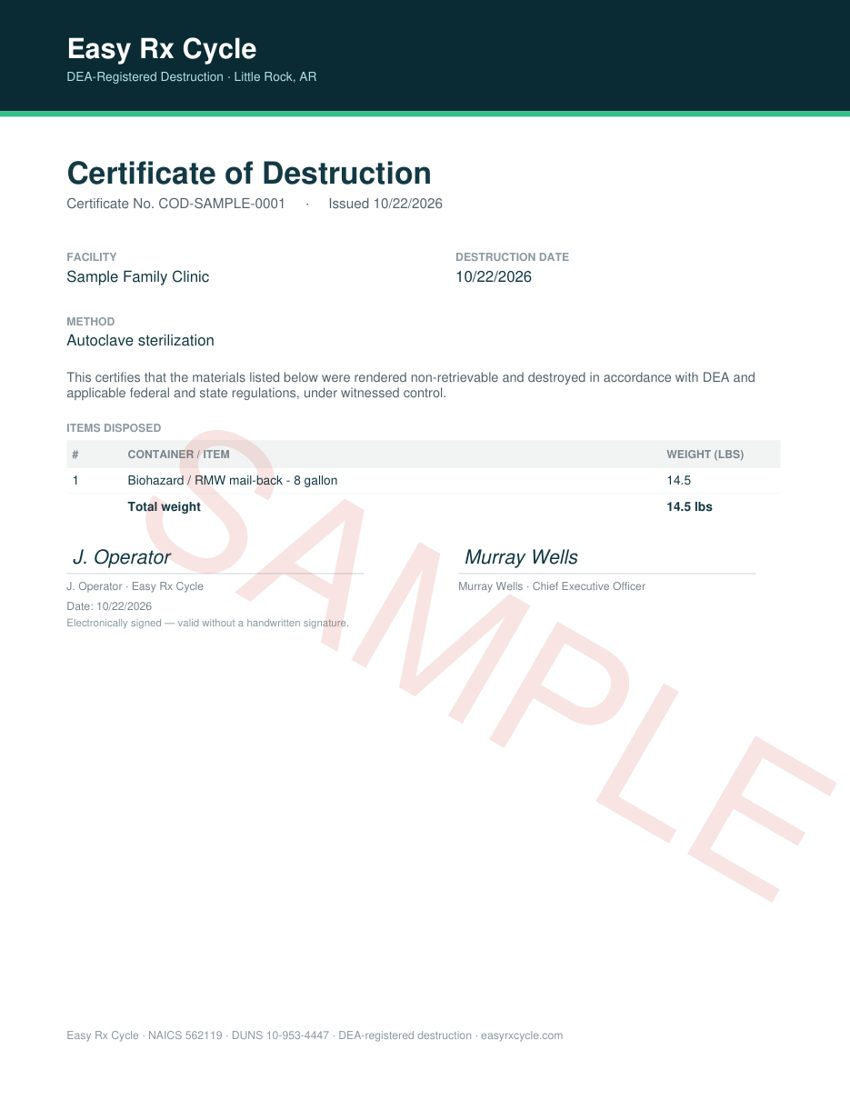
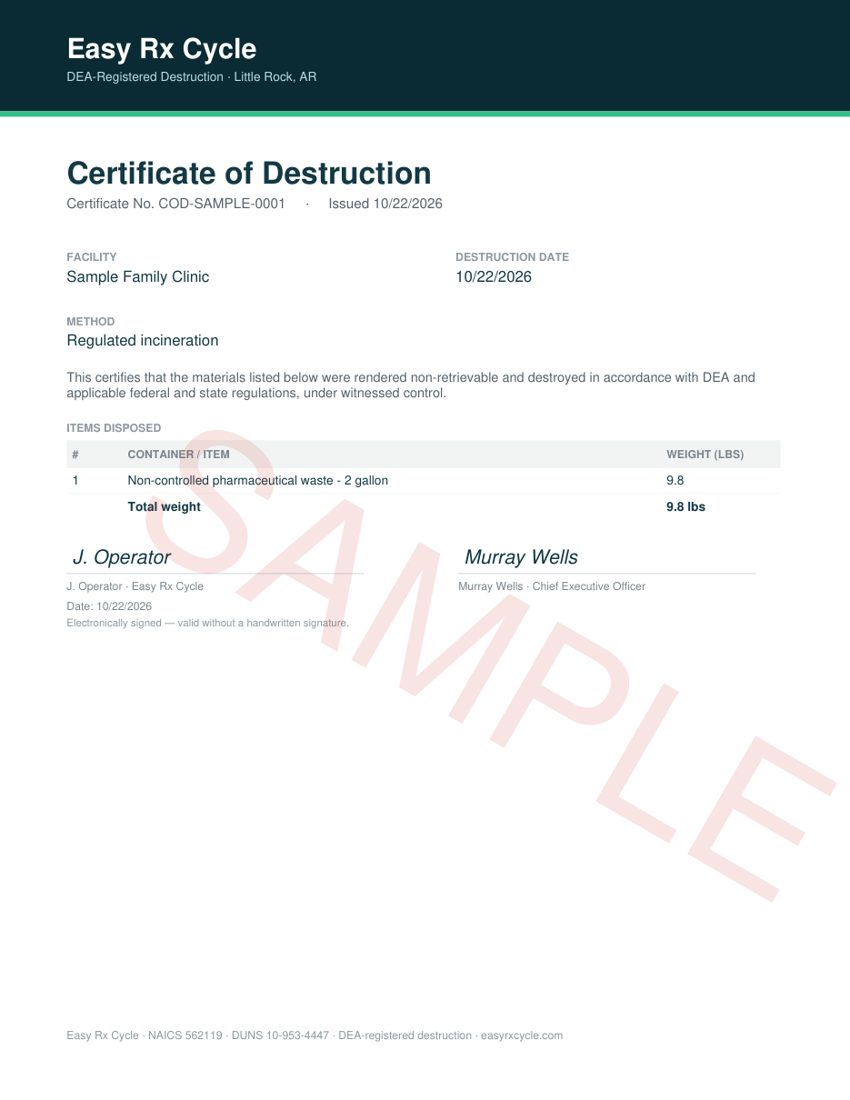
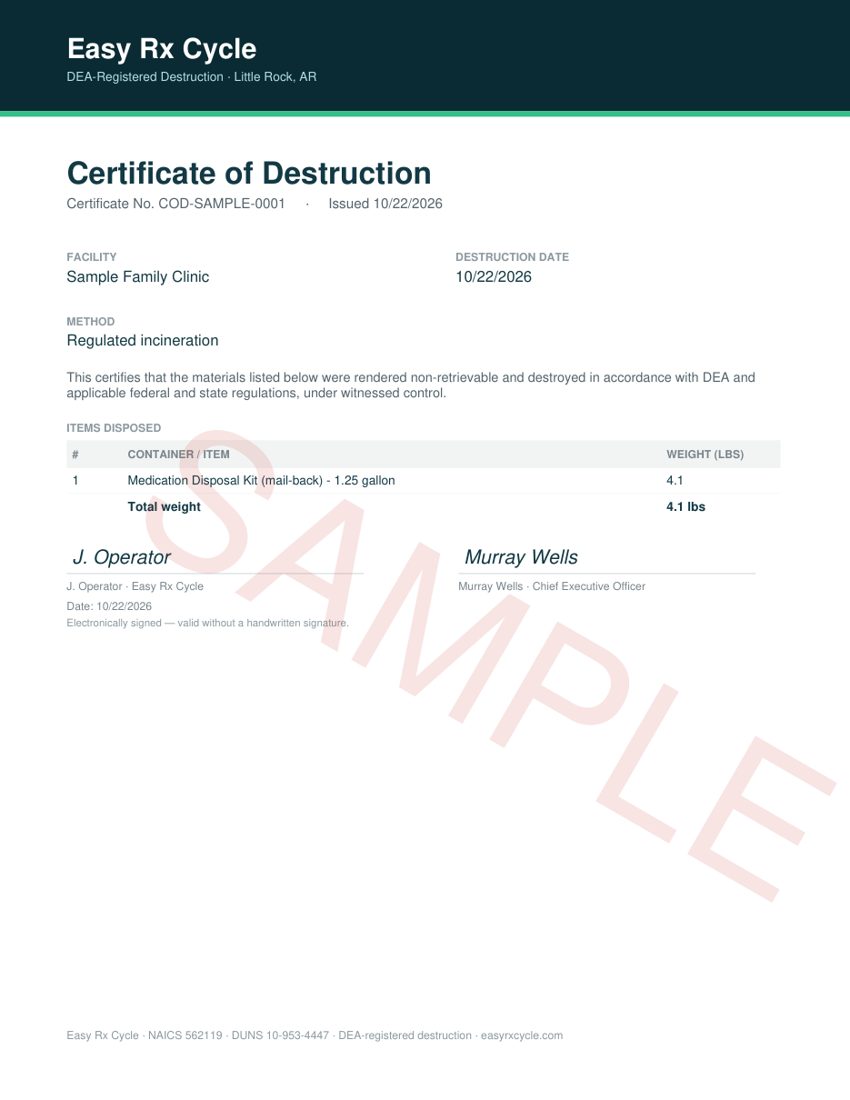
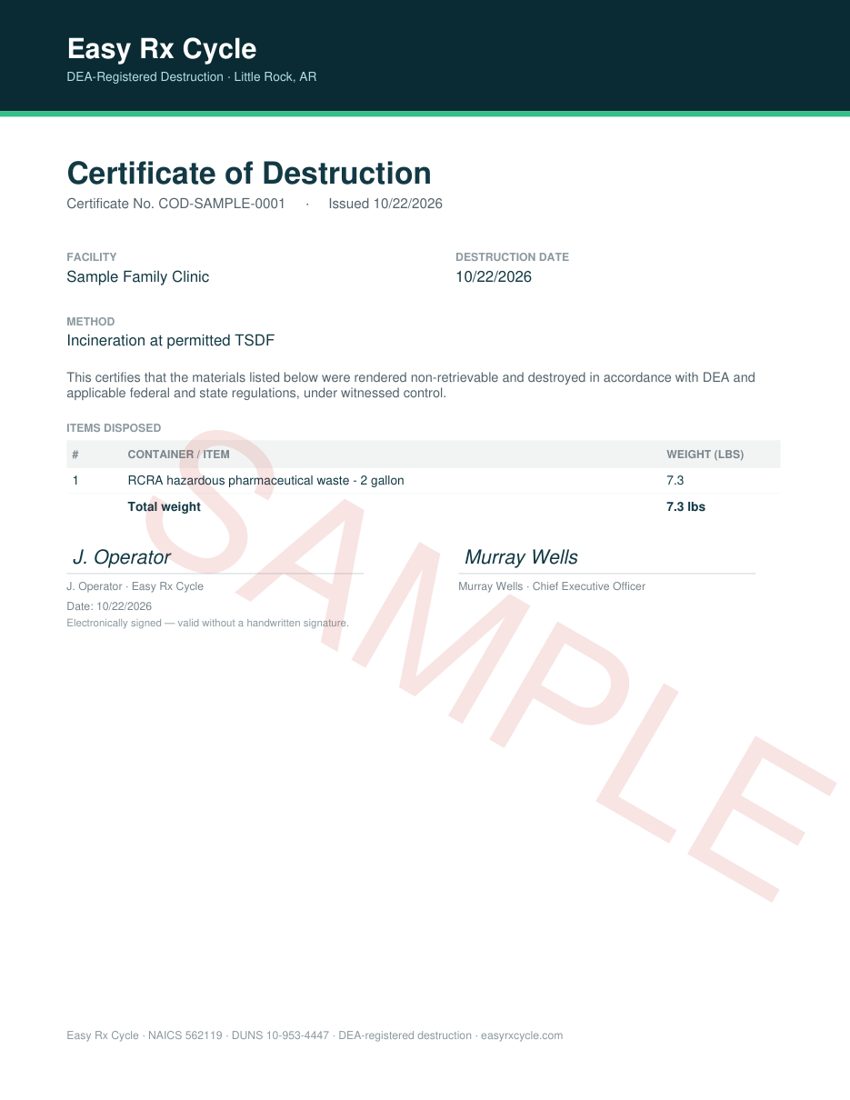
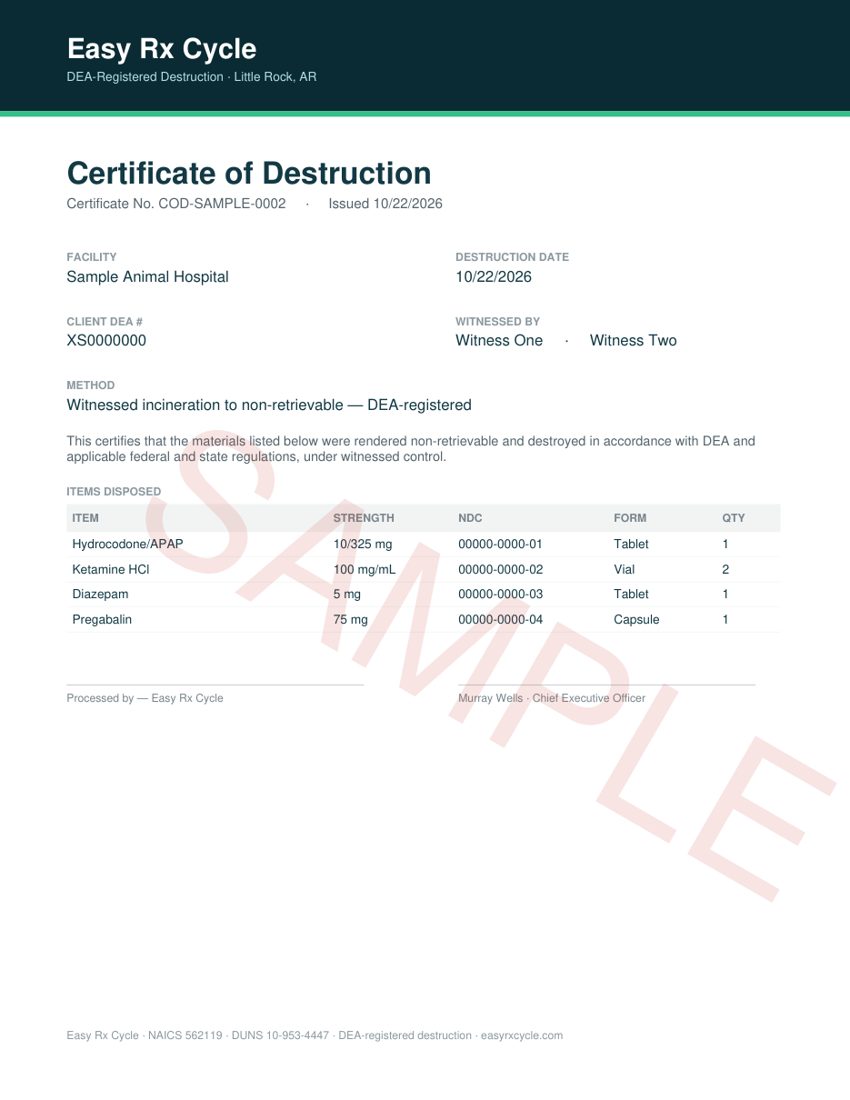
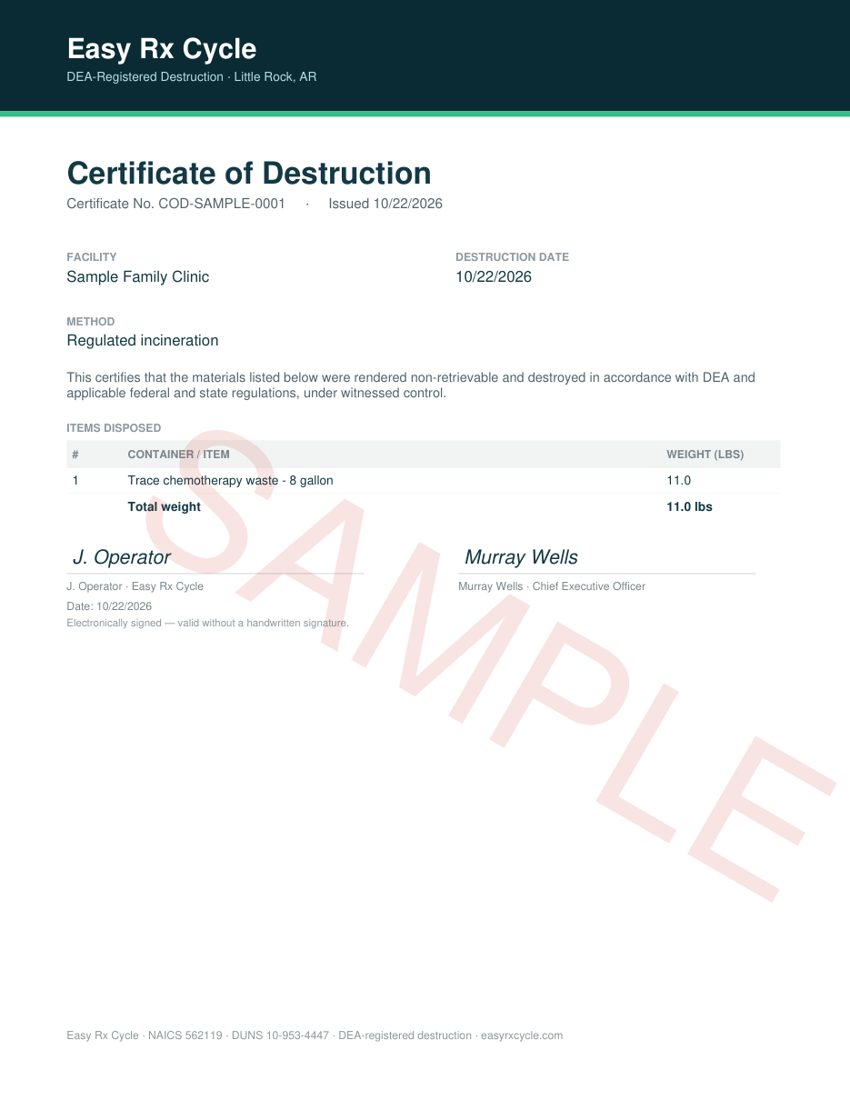
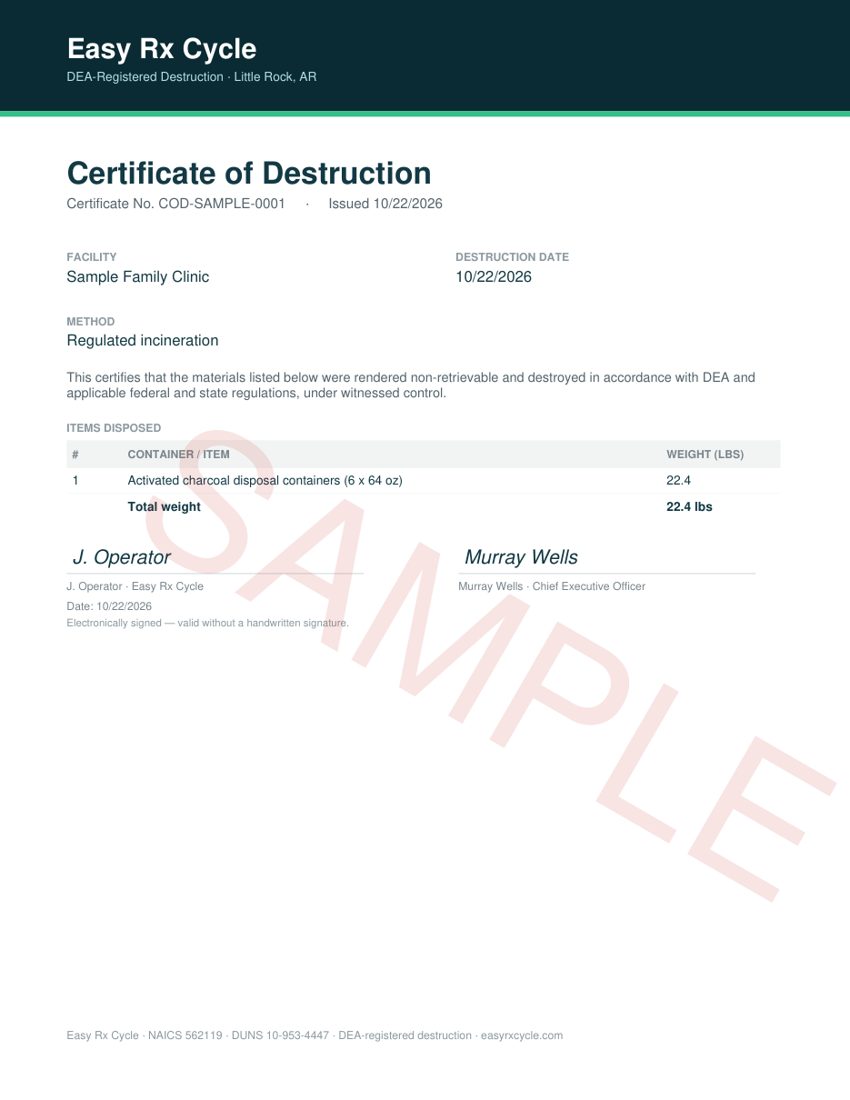
Every mail-back product comes with a Certificate of Destruction (COD) — the customer's proof that the material was destroyed, how and when, and the document they hand an inspector. Every COD carries a certificate number and issue date, the facility, the destruction date, the destruction method, and a statement that the materials were rendered non-retrievable and destroyed under federal and state rules.
| Non-controlled streams | Controlled substances | |
|---|---|---|
| Items listed | Each container with its weight, plus a total | Every drug: name, strength, NDC, form, quantity |
| Extra fields | — | Client DEA number and the two witnesses |
| Signatures | Two electronic signatures (operator and CEO) | Signed by hand |
Destruction method printed on each COD
| Stream | Method |
|---|---|
| Sharps · Biohazard | Autoclave sterilization |
| Non-controlled drugs · Trace chemo | Regulated incineration |
| RCRA hazardous | Incineration at a permitted TSDF |
| Controlled (I–V) | Witnessed incineration to non-retrievable — DEA-registered |
| Activated charcoal containers | Regulated destruction |
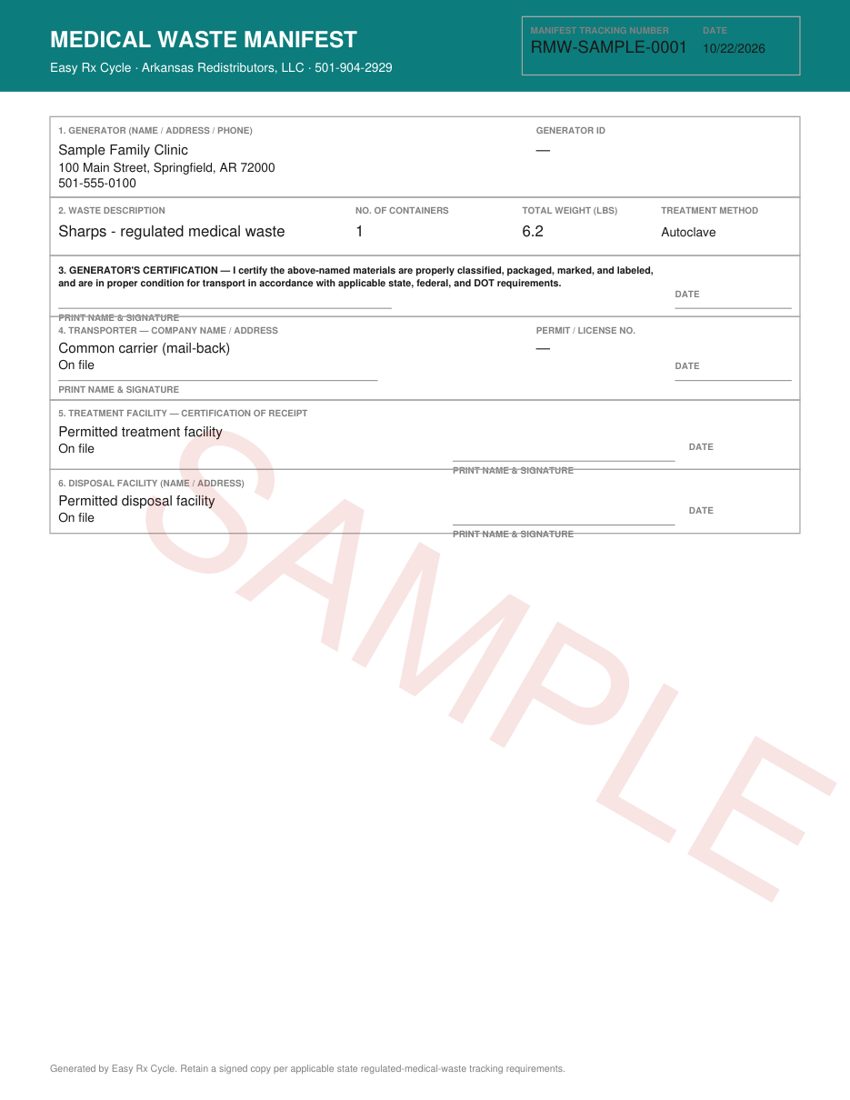
Medical Waste Manifest — required by law
Tracks regulated medical waste from the customer (the generator) through transport, treatment and disposal. It comes with Sharps, Biohazard and Trace Chemo kits.
- Manifest tracking number and date
- Generator: name, address, phone and generator ID if the state assigns one
- Waste description, number of containers, total weight and treatment method
- Generator certification: properly classified, packaged, marked and labeled
- Transporter, treatment facility and disposal facility — each with name, signature and date
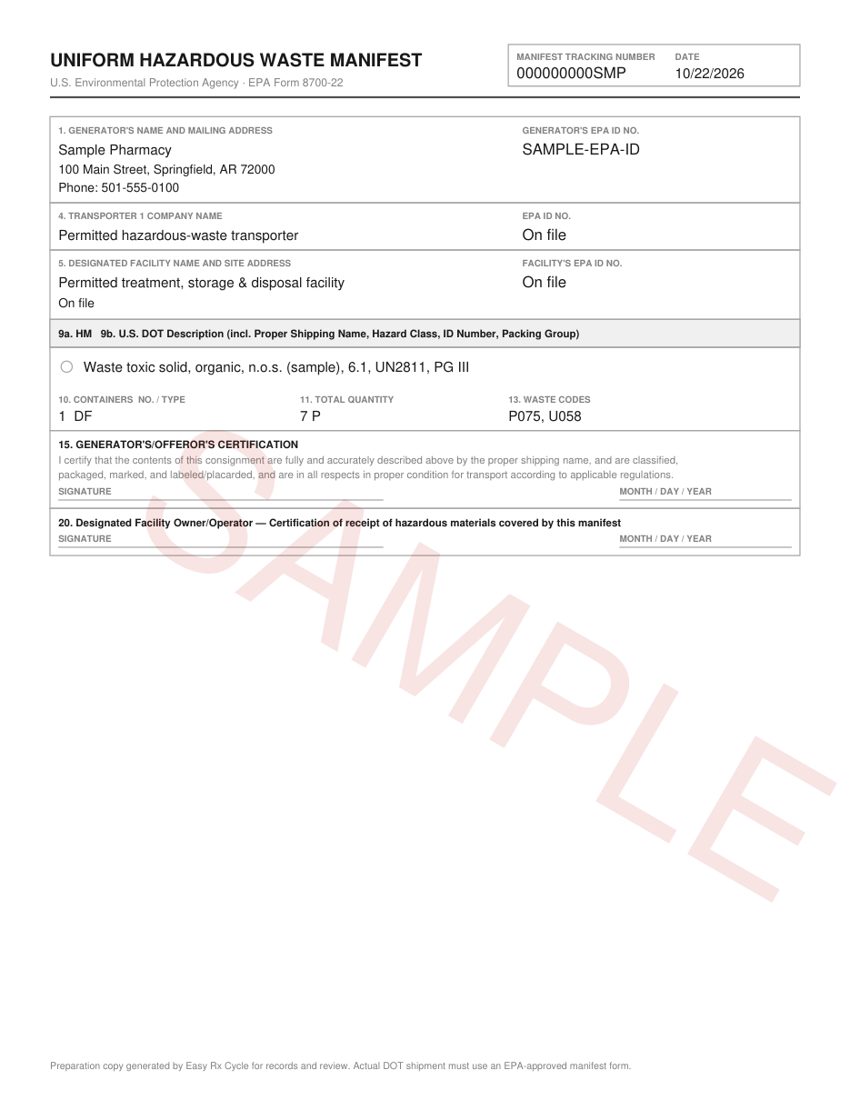
RCRA Form — EPA Form 8700-22
The Uniform Hazardous Waste Manifest: EPA's cradle-to-grave tracking form for hazardous waste, following it from the generator (the customer) to the transporter to the permitted treatment, storage and disposal facility (TSDF). Customers keep it at least 3 years.
- Manifest tracking number and date
- Generator: name, mailing address, phone and EPA ID number
- Transporter and designated facility (TSDF): names and EPA ID numbers
- U.S. DOT description: proper shipping name, hazard class, UN number and packing group
- Number and type of containers, total quantity and EPA waste codes (e.g., P075, U058)
- Generator certification and the facility's certification of receipt
Every product's documents at a glance
| Product | Customer fills out | Customer receives |
|---|---|---|
| Sharps | Nothing | COD · Medical Waste Manifest |
| Biohazard / RMW | Nothing | COD · Medical Waste Manifest |
| Pharmaceutical | Nothing | COD |
| Medication — Mail-Back | Nothing | COD |
| Medication — On-Site | Their own facility log | None (nothing ships back) |
| Controlled Substance | Drug Inventory Manifest | COD · DEA 222 (I/II) · 3–5 Form (III–V) · DEA Form 41 |
| Trace Chemo | Nothing | COD · Medical Waste Manifest |
| Hazardous (RCRA) | EPA ID number, if they have one | COD · RCRA Form (EPA 8700-22) |
| Activated Charcoal | Disposal manifest (enclosed) | COD · copy of their disposal manifest |
- Every mail-back product gets a COD.
- Controlled COD: drugs itemized, DEA number, two witnesses, hand-signed.
- Medical Waste Manifest: Sharps, Biohazard, Trace Chemo — required by law.
- EPA 8700-22: generator → transporter → TSDF; keep 3 years.
- On-Site kit: no documents.