
Pharmaceutical Waste Management: A Complete Guide
Pharmaceutical waste management is the process of sorting, storing, documenting and destroying expired, unused or contaminated medications so each stream meets EPA, DEA and state rules. Nearly every healthcare organization generates pharmaceutical waste, and it’s rarely one category. This guide covers the five types of drug waste, who is responsible, the rules that govern each, and how to get it destroyed and documented anywhere in the U.S.
Expired, non-controlled medications. Prepaid both ways, destroyed and documented. Certificate of Destruction on every order. No contract.
The streams a pharmaceutical waste program has to cover:
- Controlled substances (DEA Schedule I–V)
- Non-controlled prescription drugs
- RCRA-hazardous pharmaceuticals (P- and U-listed)
- Non-hazardous pharmaceuticals, OTC and expired stock
- Chemotherapy waste, bulk and trace
In this guide
What is pharmaceutical waste?
Pharmaceutical waste is any medication or drug product that’s no longer usable or needed — expired, unused, contaminated, or partially used. The catch is that it splits into distinct streams, each with its own rules under RCRA (EPA), the DEA, and state law. Managing it well means sorting each stream and routing it correctly. See our pharmaceutical waste disposal service.
The five types of pharmaceutical waste
1. Hazardous pharmaceutical waste
Drugs that are toxic, ignitable, corrosive, or reactive under EPA/RCRA — P-listed (warfarin, nicotine, epinephrine) and U-listed. Requires labeled, leak-proof containers, a licensed hazardous-waste transporter, and incineration at a RCRA-permitted facility. See RCRA-hazardous pharmaceutical waste.
2. Non-hazardous pharmaceutical waste
Medications not RCRA-hazardous but still an environmental risk — saline, antibiotics, OTC drugs, topicals, expired vitamins. Don’t flush; use designated containers and, for unopened stock, reverse distribution.
3. Controlled substances
DEA Schedule I–V drugs (fentanyl, morphine, ketamine, diazepam). Cannot go in the trash or be flushed — they route through a DEA-registered reverse distributor with DEA Form 41 and Form 222 handled and a Certificate of Destruction issued. See our controlled substance destruction service.
4. Compounded medications
Custom 503A/503B preparations — partial sterile injectables, failed batches, cleanroom waste with hazardous APIs. Managed per USP <800>, with hazardous, controlled, and non-hazardous components each routed correctly. See USP 800.
5. Chemotherapy waste
Bulk chemo is RCRA-hazardous (labeled containers, incineration); trace chemo (empty vials, IV bags, PPE) goes in yellow containers for incineration.
Not sure which side of the line a drug falls on? Our guide to hazardous vs. non-hazardous pharmaceutical waste walks through the tests.
Who is responsible for pharmaceutical waste management?
The facility that generates the waste is responsible for it until it is destroyed, even after a vendor takes it. For controlled substances, that responsibility sits with the DEA registrant. The most common generators:
- Pharmacies — expired and unsaleable stock, returns, damaged product and controlled substances. Most volume goes through reverse distribution.
- Clinics and physician offices — expired samples, partial vials and in-office controlled substances.
- Long-term care — discontinued and deceased-resident medications, often in large volumes.
- Dental and veterinary practices — anesthetics, sedatives, euthanasia drugs and other controlled substances.
- Hospitals — every stream at once, including RCRA-hazardous drugs and bulk chemotherapy.
Regulations & agencies
- EPA (RCRA Subpart P) — defines hazardous waste pharmaceuticals, prohibits sewering them, and sets segregation, labeling, and manifesting rules.
- DEA — controlled substances: Form 222 for Schedule II transfers, Form 41 for destruction, reverse distribution, witnessed destruction, secure storage.
- OSHA — worker safety for hazardous drugs: hazard communication, PPE, spill response, and USP <800> coordination.
- State law — adds licensing, reporting, and tracking on top of the federal baseline; requirements vary by state.
Disposing of controlled substances, step by step
- Segregate controlled drugs into labeled, dedicated containers — never mixed with hazardous or medical waste.
- Secure them in locked, DEA-compliant storage with limited access (21 CFR § 1301.72).
- Log each item in your controlled-substance log — name, strength, quantity, reason, witnesses.
- Destroy via a registered reverse distributor (incineration or chemical digestion) — never flushed.
- Document with DEA Form 41 and a Certificate of Destruction, kept at least two years.
Comparing disposal partners? See our breakdown of the best reverse distributors.
Pharmaceutical waste best practices
- Segregate at the source with color-coded, labeled containers.
- Train staff on DEA forms, RCRA identification, and state rules.
- Partner with a reverse distributor for controlled and expired drugs.
- Track and log everything — volumes, pickups, CODs, DEA forms — for at least two years.
- Choose responsible disposal — waste-to-energy incineration and landfill diversion where available.
How Easy Rx Cycle handles pharmaceutical waste management
Easy Rx Cycle is a DEA-registered reverse distributor serving all 50 states. There are two ways to send us pharmaceutical waste: prepaid mail-back kits, which you fill and ship with the included label, and scheduled on-site pickup by same-day quote for larger volumes. Either way there’s no contract, everything is destroyed by incineration, and you get a Certificate of Destruction on every order.
| Waste stream | Mail-back kit | When to choose pickup |
|---|---|---|
| Controlled substances | Controlled substance mail-back kit | Large inventories or a full pharmacy cleanout |
| Non-controlled Rx and OTC | Pharmaceutical waste mail-back kit | Several boxes a month |
| RCRA-hazardous drugs | RCRA hazardous mail-back kit | Bulk P- or U-listed stock |
| Trace chemotherapy | Trace chemo mail-back kit | Infusion centers with steady volume |
| Biohazard and sharps (separate stream) | Biohazard or sharps mail-back kit | High-volume sites |
Red-bag and sharps waste is a separate stream from drug waste. Our biohazardous waste disposal guide covers that side, and the medical waste disposal guide ties both together.
Mail-back kits and prices
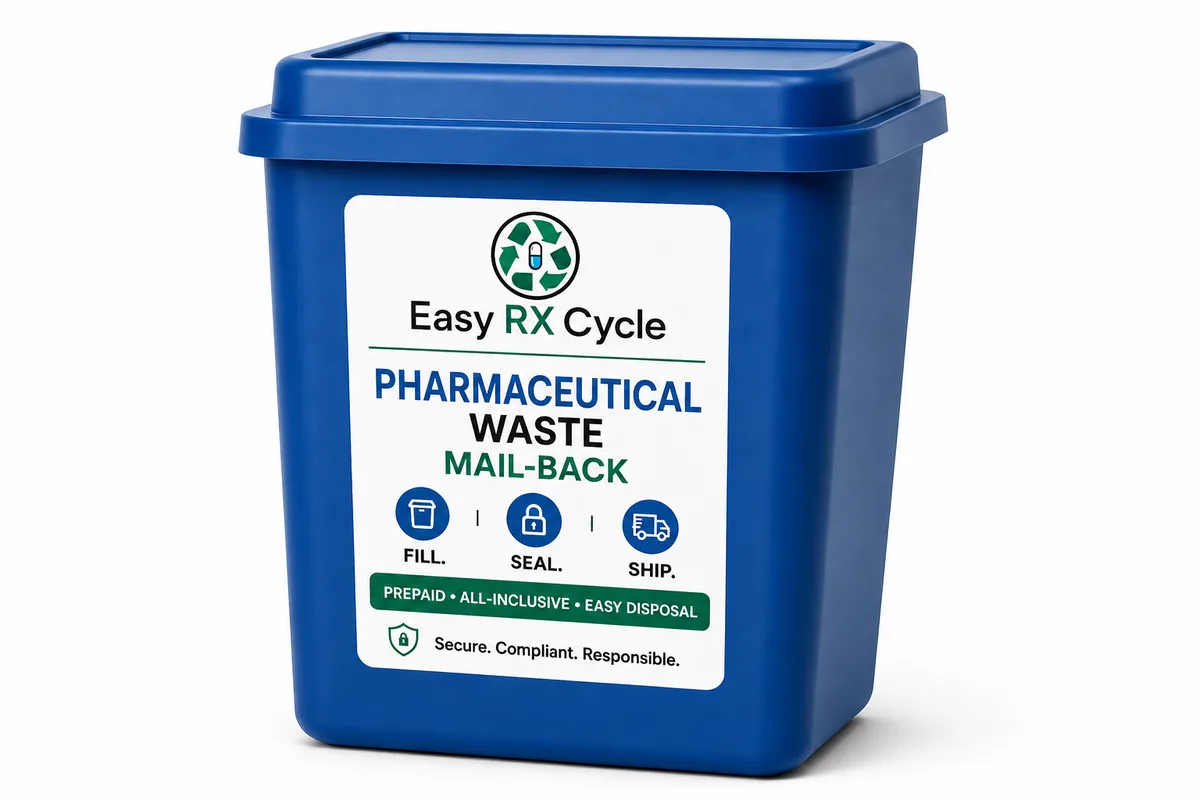
For a single site that doesn’t need a route pickup, our Pharmaceutical Waste Mail-Back Kit is priced from $100. RCRA-hazardous drugs go in an RCRA hazardous kit from $145, and sharps in a sharps kit from $55. Controlled drugs go in a separate controlled substance kit (from $499), and we handle the DEA paperwork. Each kit includes a container, prepaid return shipping and instructions, and we send a Certificate of Destruction when the contents are destroyed. No contract.
Regional coverage: pharmaceutical waste management in the Southeast and nationwide
Federal DEA and EPA rules apply everywhere, but states add their own. Several Southeastern states schedule gabapentin as a controlled substance, and states differ on whether they have adopted EPA’s Subpart P and how they license waste haulers. Easy Rx Cycle is based in Arkansas and serves facilities in every state, so the same kits, paperwork and Certificate of Destruction work wherever you are. Check your state’s rules on our regulations by state page.
Expired, non-controlled medications. Prepaid both ways, destroyed and documented. Certificate of Destruction on every order. No contract.
DEA, EPA and state rule changes that affect disposal, plus seasonal reminders. No spam, unsubscribe anytime.
Build a compliant pharmaceutical waste program.
One partner for hazardous, non-hazardous, controlled, and chemo waste — segregated, destroyed, and documented, with flat-rate pricing.
Frequently asked questions
What is pharmaceutical waste management?
It is the process of sorting, storing, documenting and destroying expired, unused or contaminated medications so each stream meets EPA, DEA and state rules. In practice that means separate containers for hazardous, non-hazardous and controlled drugs, a disposal partner for each stream, and records that prove destruction.
What is the difference between hazardous and non-hazardous pharmaceutical waste?
Hazardous pharmaceutical waste is a drug the EPA lists or that is toxic, ignitable, corrosive or reactive under RCRA, such as warfarin or nicotine. It needs RCRA handling and incineration. Non-hazardous drugs fall outside RCRA but still should not be flushed or trashed; they are incinerated too.
How are controlled substances destroyed and documented?
They are transferred to a DEA-registered reverse distributor or sent in a controlled substance mail-back kit, then destroyed so they are non-retrievable, usually by incineration. Destruction is recorded on DEA Form 41, and the registrant receives a Certificate of Destruction to keep for at least two years.
Do I get proof of destruction?
Yes. Easy Rx Cycle issues a Certificate of Destruction on every order, listing what was destroyed and when. Keep it with your DEA forms, manifests and logs; it is the first document an inspector asks for after a disposal.
What laws govern hazardous pharmaceutical waste?
It's regulated under RCRA Subpart P by the EPA, which prohibits sewering hazardous pharmaceuticals and sets labeling, storage, and transport standards. Controlled substances fall under DEA rules requiring chain-of-custody and documented destruction on Form 41.
Can I flush medications down the drain?
No. Flushing violates EPA/RCRA Subpart P and, for controlled substances, DEA rules. Use a DEA-registered reverse distributor, a mail-back kit, or an EPA-approved incineration service.
What forms do I need for DEA compliance?
DEA Form 222 for Schedule II transfers and DEA Form 41 for destruction of any Schedule I–V substance, signed by two witnesses and (since 2025) submitted electronically. Your disposal partner should help complete and retain them.
Is gabapentin a controlled drug?
Federally, no — but many states, including several in the Southeast, schedule gabapentin as a Schedule V controlled substance, which means it must be logged and disposed of under controlled-drug protocols.
What happens during a DEA or EPA audit?
Inspectors review controlled-drug logs, segregation, DEA Forms 41 and 222, Certificates of Destruction, reverse-distributor licenses, manifests, and storage security. Working with a compliant vendor keeps you audit-ready.