
How to Dispose of Controlled Drugs for Long-Term Care Facilities
Long-term care and assisted-living facilities manage controlled substances for many residents at once — opioids, benzodiazepines, and more — and unused medication piles up quickly, especially after a resident passes or a prescription changes. Here’s how to dispose of it compliantly.
Schedules I–V, sized by weight. We do all the DEA paperwork and destroy it non-retrievably. Certificate of Destruction on every order. No contract.
In this guide
What controlled drugs does long-term care facilities handle?
The DEA schedules the controlled substances long-term care facilities commonly stock:
- Schedule II: Oxycodone, hydrocodone, morphine, fentanyl patches
- Schedule III: Buprenorphine, ketamine
- Schedule IV–V: Lorazepam, alprazolam, diazepam, gabapentin (Schedule V in some states)
All of these are strictly regulated under federal and state law, and each must be disposed of through a compliant, documented process.
Why proper disposal matters
Improper disposal is a licensure and liability problem, not just paperwork. The risks: DEA fines or license revocation, environmental contamination, drug diversion or theft, and failed audits with criminal exposure. Unused medications left after a resident’s death or discharge are a major diversion risk if they aren’t secured and disposed of promptly.
DEA-compliant disposal options
1. Use a DEA-registered reverse distributor (recommended)
The most reliable, compliant option. A DEA-registered reverse distributor collects, transports, and destroys your controls — handling DEA Form 222 for Schedule II, preparing Form 41, tracking chain of custody, and issuing a Certificate of Destruction. See our controlled substance destruction service.
2. Mail-back programs
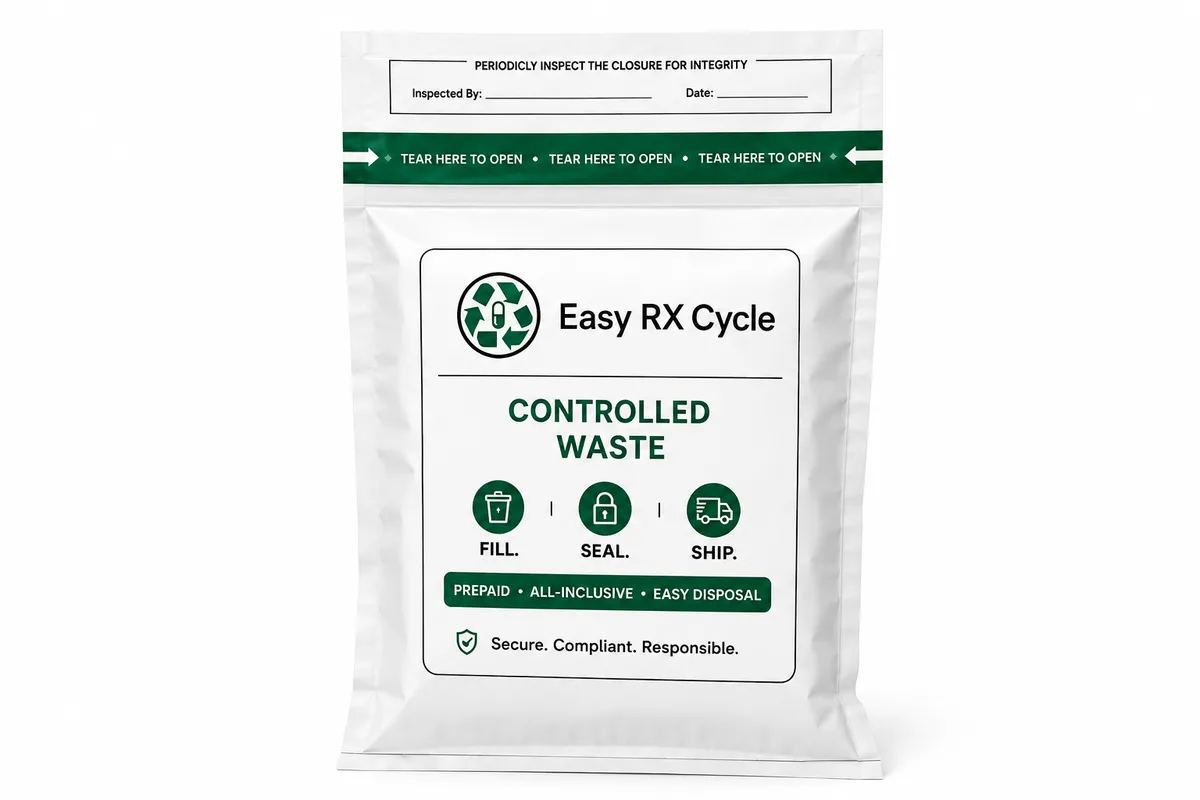
Secure, tamper-evident controlled substance mail-back kits with prepaid shipping — ideal for lower-volume or distributed sites. Fill it, seal it, ship it; we handle the DEA paperwork.
Mail-back kits for nursing homes and assisted living
For expired or discontinued controlled drugs waiting in your locked storage, our Controlled Substance Mail-Back Kit is the simplest compliant option, priced from $499. Each kit includes a tamper-evident mailer, prepaid return shipping and instructions. We handle the DEA paperwork, complete the Form 41 when we destroy the contents, and send your Certificate of Destruction. No contract.
The DEA forms you must know
Two forms cover you: DEA Form 41 and Form 222. When you use Easy Rx Cycle, we handle the DEA paperwork, including Form 222 for Schedule II transfers and Form 41 for destruction of any Schedule I–V drug. Keep the forms and your Certificates of Destruction for at least two years, and log everything in your controlled-substance log.
Common mistakes that fail audits
- Flushing controlled drugs (prohibited by DEA and EPA)
- Mixing them into general or regulated medical waste
- Missing or incomplete DEA Form 222 or 41
- Failing to log witness signatures or destruction events
- Working with an unlicensed vendor
Controlled-drug disposal checklist for long-term care facilities
- Maintain an accurate controlled-substance log
- Review inventory regularly for expired stock
- Segregate expired controls securely
- Use a DEA-registered reverse distributor
- Complete DEA Forms 222 and 41
- Retain records and CODs for two years
- Schedule disposal every 30 to 90 days based on volume
Schedules I–V, sized by weight. We do all the DEA paperwork and destroy it non-retrievably. Certificate of Destruction on every order. No contract.
DEA, EPA and state rule changes that affect disposal, plus seasonal reminders. No spam, unsubscribe anytime.
Get a DEA-compliant quote for long-term care facilities.
We handle the forms, render your controls non-retrievable, and send a Certificate of Destruction — nationwide, flat-rate, no contracts.
Frequently asked questions
How should an LTC facility dispose of a deceased resident's controlled medications?
Secure them immediately in locked storage, log them, and send them to a DEA-registered reverse distributor, by pickup or a controlled-substance mail-back kit, for documented incineration — never returned to family or flushed.
Are mail-back kits allowed in long-term care?
Yes. DEA rules permit authorized collection and mail-back of controlled substances in LTC settings, which is often the simplest compliant option.
Is gabapentin a controlled drug in long-term care?
Federally it's unscheduled, but many states classify gabapentin as Schedule V — where scheduled, it must be logged and disposed of under controlled-drug protocols.
What documentation do we need?
DEA Form 41 for destruction, Form 222 for any Schedule II transfers, Certificates of Destruction, and controlled-substance logs, all kept at least two years.
How often should we dispose of controlled drugs?
Every 30 to 90 days, and promptly whenever medications are discontinued or a resident leaves, to limit accumulation and diversion risk.