
How to Dispose of Controlled Drugs for Ambulance Services
EMS providers carry controlled substances into the field every day — opioids, sedatives, and emergency medications. That makes your service a DEA registrant with strict obligations for storage, tracking, and disposal. Here’s how to dispose of controlled drugs compliantly.
Schedules I–V, sized by weight. We do all the DEA paperwork and destroy it non-retrievably. Certificate of Destruction on every order. No contract.
In this guide
What controlled drugs does EMS teams handle?
The DEA schedules the controlled substances EMS teams commonly stock:
- Schedule II: Morphine, fentanyl, hydromorphone
- Schedule III: Ketamine, buprenorphine
- Schedule IV–V: Diazepam, midazolam, lorazepam
All of these are strictly regulated under federal and state law, and each must be disposed of through a compliant, documented process.
Why proper disposal matters
Improper disposal is a licensure and liability problem, not just paperwork. The risks: DEA fines or license revocation, environmental contamination, drug diversion or theft, and failed audits with criminal exposure. For mobile units especially, unsecured or expired drugs on a rig are a diversion and audit risk.
DEA-compliant disposal options
1. Use a DEA-registered reverse distributor (recommended)
The most reliable, compliant option. A DEA-registered reverse distributor collects, transports, and destroys your controls — handling DEA Form 222 for Schedule II, preparing Form 41, tracking chain of custody, and issuing a Certificate of Destruction. See our controlled substance destruction service.
2. Mail-back programs
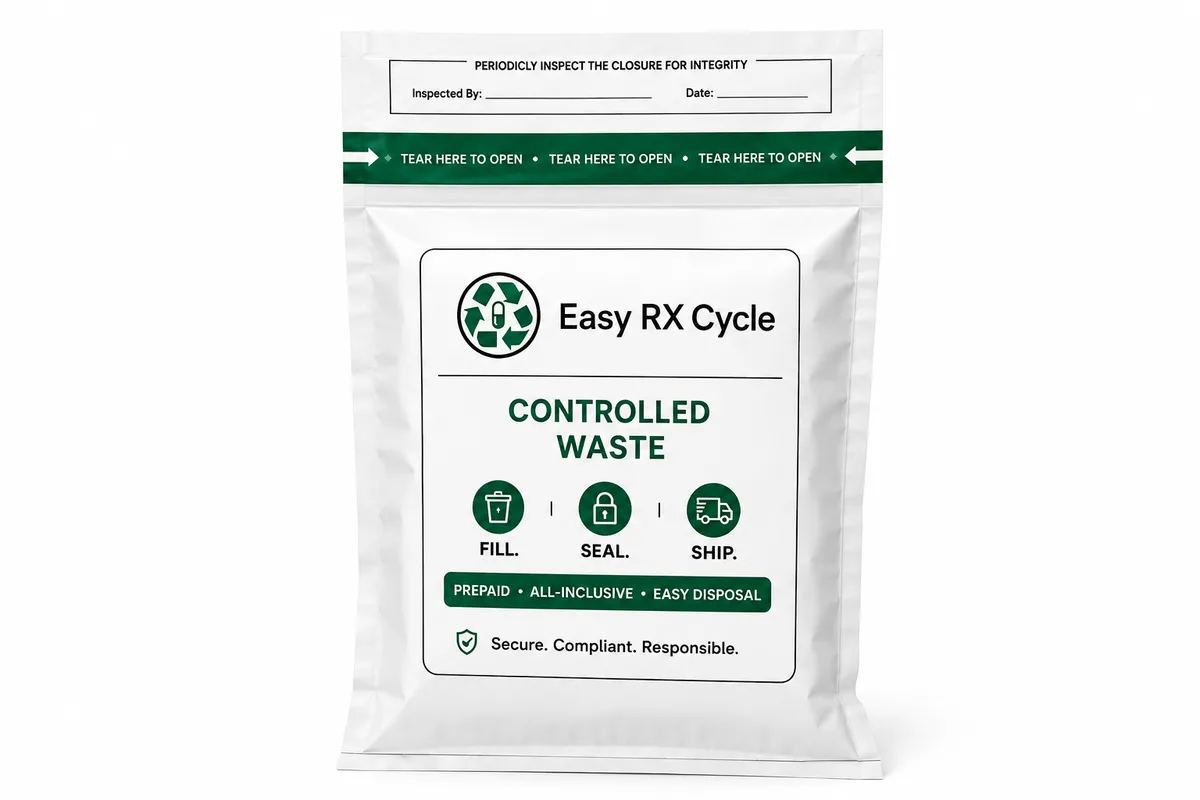
Secure, tamper-evident controlled substance mail-back kits with prepaid shipping — ideal for lower-volume or distributed sites. Fill it, seal it, ship it. We incinerate the contents and complete the DEA Form 41 as the destroying registrant.
3. Return to your supplying hospital or pharmacy
Many agencies stock their rigs under a hospital’s or pharmacy’s registration. If that’s your setup, expired controls may have to go back to that registrant, which then sends them to a reverse distributor. DEA rules allow return to the registrant you got the drugs from (21 CFR 1317.05), and some states require it. Check your supply agreement.
Mail-back kits for EMS stations and rigs
For a single station, a volunteer squad, or expired stock pulled from several rigs, our Controlled Substance Mail-Back Kit is the simplest compliant option, priced from $499. Each kit includes a tamper-evident mailer, prepaid return shipping and instructions. We handle the DEA paperwork, complete the Form 41 when we destroy the contents, and send your Certificate of Destruction. No contract.
Expired fentanyl, midazolam and ketamine
These three drive most EMS disposal questions. Each sits in a different DEA schedule, and the schedule sets the paperwork:
| Drug | DEA schedule | Transfer paperwork to the reverse distributor |
|---|---|---|
| Fentanyl | Schedule II | DEA Form 222 (or a CSOS electronic order), issued by the receiving registrant |
| Ketamine | Schedule III | A written transfer record listing each drug and quantity |
| Midazolam | Schedule IV | A written transfer record listing each drug and quantity |
Expired stock is still inventory. Keep it on your controlled-substance log, segregate it from in-date stock, and keep it locked until it leaves. Pull it from every rig and station on a set schedule so expired vials don’t sit in drug boxes. Then send it to a DEA-registered reverse distributor for incineration. The reverse distributor completes Form 41 as the registrant that destroys it and sends you a Certificate of Destruction. For low volumes or scattered stations, a Controlled Substance Mail-Back Kit per station works well.
Registration is changing too. In February 2026 DEA published a final rule creating a registration category for EMS agencies under the Protecting Patient Access to Emergency Medications Act of 2017 (Federal Register, Feb. 5, 2026). Whose registration your stock sits under decides who transfers it out.
Wastage vs. inventory
These are two different things, and audits often find them mixed up.
- Wastage is the leftover from a dose drawn for a patient: the 50 mcg left in a 100 mcg fentanyl vial after you give 50. DEA’s 2014 disposal rule says this remainder is recorded under 21 CFR 1304.22(c), does not go on Form 41 (21 CFR 1304.21(e)), and may not be put in a collection receptacle. Waste it at the time, with a witness, under your agency’s protocol and state rules, and record it.
- Inventory is everything else: expired, damaged, recalled or unneeded vials and prefilled syringes that were never drawn for a patient. Inventory goes to a reverse distributor (or back to your supplier) with the transfer paperwork above.
A simple test: if it was never drawn up for a patient, it’s inventory.
Ohio’s EMS rule (4729:5-14-03)
Ohio spells this split out in Ohio Adm. Code 4729:5-14-03, “Security and control of dangerous drugs” (version effective December 1, 2025):
- Wastage: the unused portion of a controlled substance left after administration may be destroyed on site by two licensed or certified EMS personnel. The method must make the drug unavailable and unusable; it doesn’t have to meet the non-retrievable standard.
- Expired controls at a non-DEA-registered EMS organization: they go back to the institutional pharmacy or hospital that serves as the responsible DEA registrant.
- Storage limit: adulterated or expired drugs may be held for no more than one year from the date of adulteration or expiration.
Other states have their own EMS drug rules. Check your state board of pharmacy and EMS office.
Reverse distributor vs. asking law enforcement to take it
Agencies sometimes ask whether the police department’s take-back box can absorb expired rig stock. Here is how the two compare under federal rules:
| DEA-registered reverse distributor | Law-enforcement take-back | |
|---|---|---|
| Who it serves | DEA registrants disposing of their own inventory | Ultimate users and other non-registrants (patients, households, a deceased person’s estate) |
| Federal basis | Listed as a registrant disposal option in 21 CFR 1317.05 | 21 CFR 1317.30 and 1317.35; not listed as a registrant option in 1317.05 |
| Schedule II transfer | DEA Form 222 or CSOS order | No registrant transfer path |
| Destruction record | Reverse distributor completes Form 41; you get a Certificate of Destruction | Nothing that closes out your controlled-substance log |
Bottom line: rig stock goes to a reverse distributor, back to your supplying registrant, or wherever the DEA Special Agent in Charge directs if you ask for help. Patients’ own leftover medications are what take-back boxes are for.
The DEA forms you must know
Two forms cover you: DEA Form 41 and Form 222. When you use Easy Rx Cycle, we handle the DEA paperwork, including Form 222 for Schedule II transfers and Form 41 for destruction of any Schedule I–V drug. Keep the forms and your Certificates of Destruction for at least two years, and log everything in your controlled-substance log.
Common mistakes that fail audits
- Flushing controlled drugs (prohibited by DEA and EPA)
- Mixing them into general or regulated medical waste
- Missing or incomplete DEA Form 222 or 41
- Failing to log witness signatures or destruction events
- Working with an unlicensed vendor
Controlled-drug disposal checklist for EMS teams
- Maintain an accurate controlled-substance log
- Review inventory regularly for expired stock
- Segregate expired controls securely
- Use a DEA-registered reverse distributor
- Let your reverse distributor handle the DEA paperwork (Form 222 for Schedule II and Form 41)
- Retain records and CODs for two years
- Schedule disposal every 30 to 90 days based on volume
Schedules I–V, sized by weight. We do all the DEA paperwork and destroy it non-retrievably. Certificate of Destruction on every order. No contract.
DEA, EPA and state rule changes that affect disposal, plus seasonal reminders. No spam, unsubscribe anytime.
Get a DEA-compliant quote for EMS teams.
We handle the forms, render your controls non-retrievable, and send a Certificate of Destruction — nationwide, flat-rate, no contracts.
Frequently asked questions
Can ambulance services flush controlled drugs?
No — flushing is prohibited by the DEA and EPA and poses environmental hazards.
How often should EMS teams dispose of controlled drugs?
Every 30 to 90 days depending on inventory and usage. Easy Rx Cycle can help set a schedule.
Are mail-back programs safe for mobile EMS units?
Yes — they provide secure, DEA-compliant disposal without a pickup, which suits distributed or mobile units well.
What documentation is required for audits?
DEA Forms 222 and 41, Certificates of Destruction, and your controlled-drug logs, retained at least two years.
What is a reverse distributor?
A DEA-registered company that collects, transports, and destroys controlled drugs on your behalf, providing full compliance documentation.
How do we dispose of expired fentanyl, midazolam or ketamine?
Expired stock is inventory, not wastage. Keep it logged and locked, then transfer it to a DEA-registered reverse distributor (or back to the hospital or pharmacy that supplies you, where that is your arrangement). Fentanyl is Schedule II and moves on a DEA Form 222; ketamine (Schedule III) and midazolam (Schedule IV) move on a transfer record. The reverse distributor completes Form 41 and sends a Certificate of Destruction.
Is wasting a partial dose the same as disposing of inventory?
No. The leftover from a dose drawn for a patient is wastage. DEA's 2014 disposal rule says it is recorded under 21 CFR 1304.22(c) and does not go on Form 41, and it may not go in a collection receptacle. Witness and record it under your agency's protocol and state rules. Expired or unwanted stock is inventory and goes to a reverse distributor.
Can we give expired controlled drugs to a police take-back box?
No. Law-enforcement take-back collects from ultimate users and other non-registrants (21 CFR 1317.30 and 1317.35). A DEA registrant's stock is not on that list. The registrant options in 21 CFR 1317.05 include transfer to a reverse distributor, return to your supplier, or asking the DEA Special Agent in Charge for help.