
Where to Dispose of Sharps Containers
A full sharps container has only a few legal destinations, and which one you can use depends on who generated the sharps. This reference covers every setting (clinics and other businesses, schools, tattoo studios, travel and home users), the OSHA container rules, and how state rules differ.
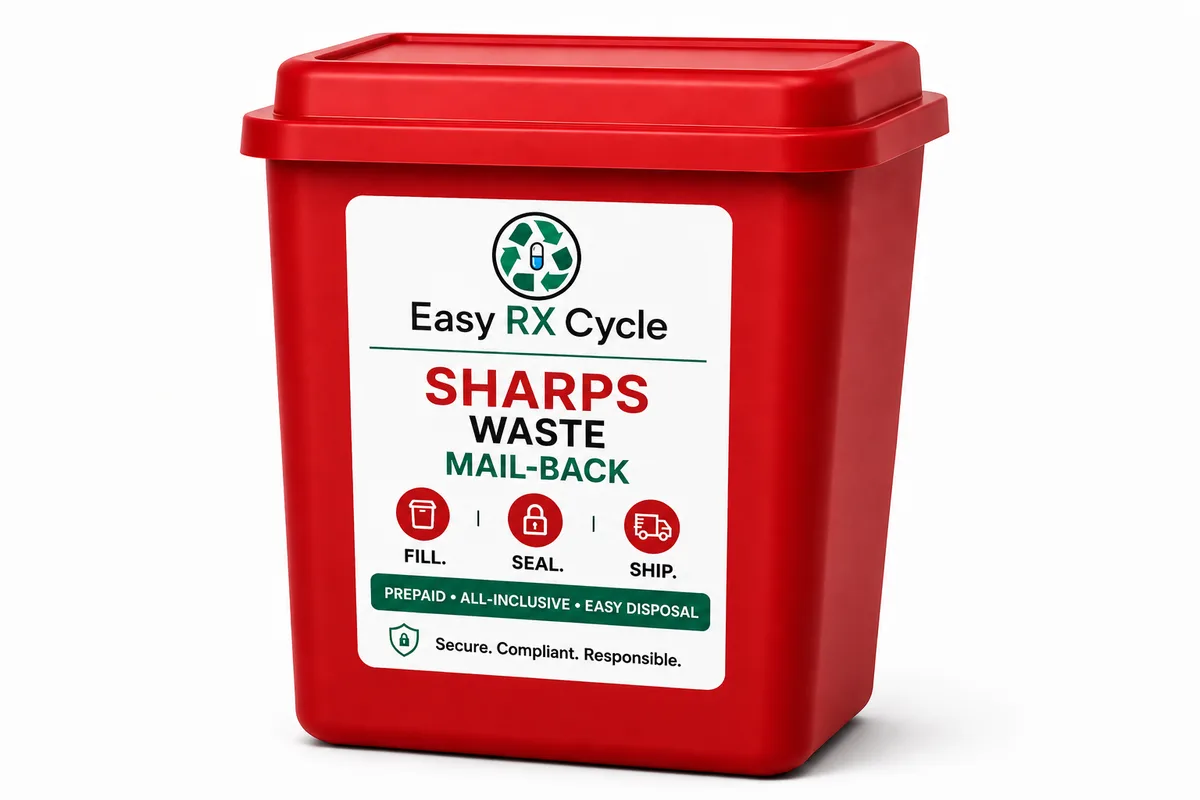
Needles, syringes, lancets and pen needles. FDA-cleared container, prepaid both ways. Certificate of Destruction on every order. No contract.
At a glance: where a full container can go
| Who generated it | Approved destinations | Not allowed |
|---|---|---|
| Clinics, pharmacies, dental and veterinary offices | Licensed medical waste hauler; sharps mail-back program | Trash, recycling, household drop-off sites |
| Hospitals, surgery centers, labs | Scheduled hauler pickup (often paired with mail-back for satellite sites) | Trash, mixing with red-bag waste |
| Schools and colleges | Hauler or mail-back, managed by the nurse or health office | Classroom trash, student take-home |
| Tattoo, piercing and body art studios | Hauler or mail-back, with records kept for the state or county inspector | Trash, home disposal by artists |
| Home health, hospice, mobile and travel clinicians | Mail-back, or return to the agency’s collection point | Patient’s household trash |
| Households (secondary) | Community drop-off or kiosk, household hazardous waste event, mail-back; trash only where the state allows it | Recycling bins, loose in the trash, toilets |
In this reference
What makes a sharps container compliant
In a workplace, OSHA’s Bloodborne Pathogens Standard (29 CFR 1910.1030) sets the requirements. A sharps container must be:
- Closable, with a lid that seals for handling and transport
- Puncture-resistant
- Leakproof on the sides and bottom
- Labeled or color-coded with the biohazard symbol, or red
- Easily accessible, as close as feasible to where sharps are used
- Kept upright while in use
For home users, the FDA recommends an FDA-cleared sharps container. If one isn’t available, the FDA says a heavy-duty plastic household container (such as a laundry detergent bottle) can serve, provided it is puncture-resistant, upright and stable, leak-resistant, has a tight lid, and is labeled as containing sharps.
| Container size | Typical setting |
|---|---|
| 1–2 quart | Exam rooms, home health bags, travel, school nurse kits |
| 2–5 quart | Injection stations, tattoo stations, dental operatories, small veterinary clinics |
| 2–8 gallon | Urgent care, busy clinics, pharmacies offering immunizations |
| 12–28 gallon | Hospitals, surgery centers, labs, central collection points |
When a container is full, and how to close it
A container is full when the contents reach the manufacturer’s fill line, typically about three-quarters. OSHA requires containers to be replaced routinely and not allowed to overfill. When it’s full:
- Stop using it. Never push sharps down, shake it or reach inside.
- Close and lock the lid using the container’s permanent closure.
- If the outside may be contaminated, place it in a second container that meets the same standard.
- Store it upright in a secure area until it is shipped or picked up.
- Keep the shipping record and the Certificate of Destruction when it comes back.
The three disposal routes
1. Mail-back program
You receive an approved container, fill it, seal it in the supplied outer packaging and return it by mail with a prepaid label. The Postal Service accepts sharps and certain other regulated medical waste only when the packaging, markings and paperwork meet its mailing standards (USPS Publication 52 and the Domestic Mail Manual), which is why the container and box come as a matched system. Mail-back fits most offices, schools, studios, home health agencies and rural sites: there is no contract and no pickup schedule. See our sharps disposal options.
2. Licensed medical waste hauler
A permitted transporter collects sealed containers on a schedule and takes them to a treatment facility, with a manifest or tracking document for each pickup. This suits high-volume generators, and it usually comes with a service contract. Sharps are often collected alongside regulated medical waste.
3. Community drop-off (households only)
Some pharmacies, hospitals, fire stations, health departments and household hazardous waste programs accept home-generated sharps. These programs are usually limited to residents and should not be used for business waste. Availability varies by county.
Sharps mail-back kits
For clinics, pharmacies and people who inject at home, our Sharps Mail-Back Kit is the simplest of the three routes and works in all 50 states, priced from $55 for the smallest size. Each kit includes an FDA-cleared container, a prepaid return label and instructions. Fill it, seal it, ship it back, and we send a Certificate of Destruction. No contract.
Disposal by setting
Clinics, pharmacies, dental and veterinary offices
Place a container at each point of use, train staff under your exposure control plan, and send full containers to treatment through a hauler or mail-back. Pharmacies offering immunizations generate more sharps than they expect; a 2-gallon mail-back container per immunization station is a common setup. Industry guides: dental, veterinary, physician offices.
Schools and colleges
The nurse or health office normally manages sharps from insulin, epinephrine auto-injectors and other student medications. Keep a container in the health office and on field-trip kits, and send full containers out through a hauler or mail-back. Never send used sharps home with a student. See school health.
Tattoo, piercing and body art studios
State and county body art rules generally require a sharps container at each station and disposal through a permitted hauler or approved mail-back program, with records an inspector can review. OSHA’s bloodborne pathogens rules apply to employees. See tattoo and body art.
Home health, hospice and mobile clinicians
Sharps used by a clinician in a patient’s home are generated by the agency, not the household. Carry a portable container in each bag and return full containers to the agency’s collection point or a mail-back container. See home health and hospice.
Travel
Carry a small travel container. The TSA allows syringes when they are accompanied by injectable medication; keep the medication in its labeled packaging. Some airlines provide sharps containers in the lavatory. Bring used sharps home for disposal or use a mail-back container.
Households
Self-injectors (insulin, GLP-1 pens, fertility medications, biologics) can use community drop-off where it exists, a mail-back container, or, only where state law allows, a sealed and labeled container in the trash. More detail: how to dispose of sharps at home and GLP-1 pen disposal.
How state rules differ
Federal rules cover workplace safety (OSHA) and transport (DOT and USPS). Most of the rest is set by each state’s health or environmental agency, and the differences that matter most are:
- Household sharps in the trash. Some states allow a sealed, labeled household container in the trash; others prohibit it. California, for example, bans home-generated sharps from the trash.
- Who may transport. Many states require medical waste transporters to be registered or permitted. Mail-back programs operate under Postal Service rules, and some states set additional conditions on them.
- Storage limits. States set how long full containers may be stored on site before shipment, and some require refrigeration after a set time.
- Generator registration. Some states require generators of medical waste to register or keep a written management plan.
Look up your state in our medical waste regulations by state guide, and check county rules as well; local health departments often add requirements. For how state and county pages compare, see our 50-state review of disposal guidance.
Common mistakes
- Overfilling. Containers packed past the fill line cause needlesticks and are a common OSHA citation.
- Loose sharps in a red bag. Bags are not puncture-resistant.
- Using household drop-off for business waste. Most community programs are residents-only.
- Improvised containers in a workplace. Coffee cans and bottles don’t meet OSHA’s requirements for employers.
- No paper trail. Keep shipping records and Certificates of Destruction; inspectors ask for them.
Sources
- OSHA Bloodborne Pathogens Standard, 29 CFR 1910.1030
- U.S. Food and Drug Administration, Safely Using Sharps (Needles and Syringes) at Home, at Work and on Travel
- U.S. Postal Service, Publication 52, Hazardous, Restricted, and Perishable Mail
- Transportation Security Administration, travelers with medical conditions
This page is general information, not legal advice. State and local requirements vary; confirm with your state health or environmental agency.
Needles, syringes, lancets and pen needles. FDA-cleared container, prepaid both ways. Certificate of Destruction on every order. No contract.
DEA, EPA and state rule changes that affect disposal, plus seasonal reminders. No spam, unsubscribe anytime.
Sharps disposal without a contract.
Prepaid mail-back kits from 1 quart to 28 gallons, FDA-cleared containers, and a Certificate of Destruction for every return. Or call us to set up pickup.
Frequently asked questions
Where can a business dispose of a full sharps container?
A business that generates sharps (a clinic, dental or veterinary office, pharmacy, school, tattoo studio, home health agency) must send them to a permitted medical waste treatment facility, either through a licensed medical waste hauler or through a mail-back program. Household drop-off sites and community kiosks are generally for residents only and should not be used for business waste.
Can a sharps container go in the regular trash?
Not from a business. Sharps generated by a healthcare or other workplace setting are regulated medical waste and must be treated at a permitted facility. For households, the answer depends on the state: some states allow a sealed, labeled household container in the trash, while others, including California, prohibit home-generated sharps in the trash entirely. Check your state and local rules before using the trash.
When is a sharps container considered full?
When the contents reach the manufacturer's fill line, which is usually about three-quarters full. OSHA's Bloodborne Pathogens Standard requires containers to be replaced routinely and not allowed to overfill. Never push sharps down or shake the container to make room.
Is mail-back a legal way to dispose of sharps?
Yes, when you use a mail-back program built for it. The U.S. Postal Service accepts sharps and certain other regulated medical waste only in packaging that meets its mailing standards, with the proper markings and documentation. A legitimate program provides the approved container, the outer packaging, a prepaid label and a record of destruction.
Do I need a licensed hauler for sharps?
Not if your volume suits mail-back. Scheduled pickup by a licensed hauler makes sense for high-volume generators such as hospitals and surgery centers. Lower-volume generators, which is most offices, often find mail-back simpler and cheaper, with no contract or pickup schedule.
Can sharps and red-bag waste go in the same container?
No. Sharps must go in a rigid, puncture-resistant sharps container. A red bag is not puncture-resistant, so loose sharps in a red bag are an injury risk and a violation. A sealed sharps container may be placed inside a larger biohazard box for transport, if your hauler or program allows it.
How do I travel with sharps?
Carry a small portable sharps container. The TSA allows syringes when they are accompanied by injectable medication; keep the medication in its labeled packaging. Some airlines provide sharps containers in the lavatory. Bring the used container home for disposal, or use a mail-back container.